
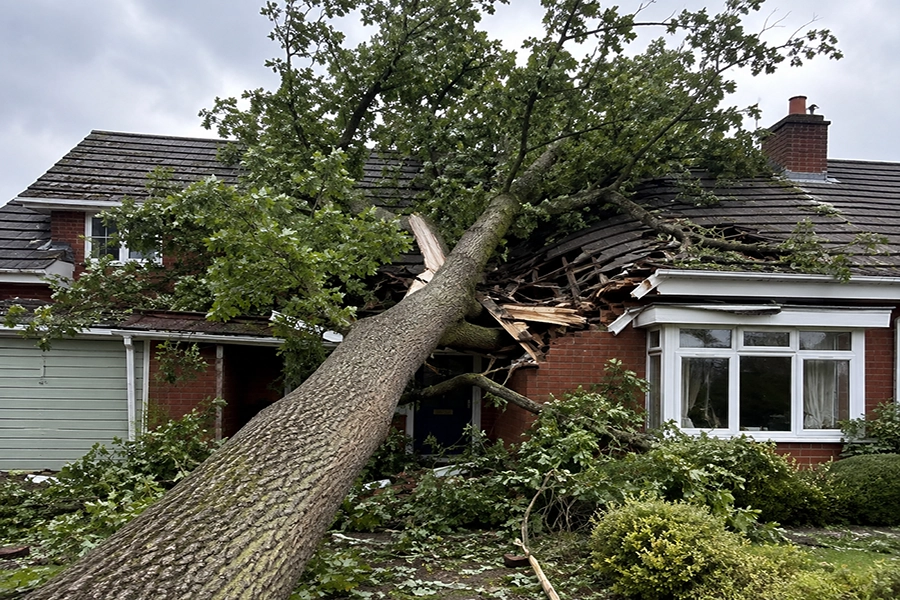
Ongoing drought conditions throughout the UK have presented a significant challenge for the plant life of the country.
Trees may have become excellent spots to escape from harsh sunlight, but ongoing dry conditions can leave them vulnerable.
If a neighbour’s tree causes damage to your property, you need to know how best to handle the situation and who is liable for the damage.
Does the law protect against damage from trees?
When considering your position, the question of whether the damage counts as private nuisance will be addressed.
You have the legal right to enjoy your property without any unreasonable interference, so anything that infringes on this might be considered illegal.
Trees occupy an interesting position as the extent to which they were maintained affects who is liable for damage they caused.
If a tree is well maintained but then gets damaged by a sudden storm, the resulting damage to your property will be considered your responsibility to address, as little could have been done to prevent it.
However, if a tree is already dead, diseased, unstable or visibly unsafe before it or any of its branches fall, then the owner of the tree may be liable.
This extends to the roots of the tree, which can also cause direct property damage or create problems with subsidence or drainage.
How do I take legal action when a tree damages my property?
Ideally, you should be keeping an eye on trees that neighbour your property and monitor them for signs of damage or decay.
This will let you raise the issue with your neighbour before any damage occurs and give them a chance to tend to the tree.
You should gather evidence of this process as well as any indications that a tree may be in poor condition.
Raising the issue informally with your neighbour may be sufficient for them to take action, but if they ignore their duty then you can escalate the matter further to try to mitigate the risk that the tree will cause damage.
If damage has already been caused, it is necessary to document the damage and attempt to get the tree independently assessed to determine whether the cause was neglect.
This may be a costly procedure, but having to pay for repairs that are the fault of someone else is not ideal.
You may find that you and your neighbour can come to a settlement through mediation, though it can sometimes be necessary to take the matter to court.
If going to court, the evidence you have gathered will be extremely useful.
Do you know who owns the tree?
An important thing to note before approaching tree maintenance and damage from a legal perspective is who owns the tree.
If it is on your land, it’s yours. If it’s on your neighbour’s land, it’s theirs. If on public land, it is the responsibility of the council.
Issues with council-owned trees must be raised with local authorities, who should then deal with them appropriately.
Some trees are protected by a Tree Preservation Order (TPO) or might be difficult to handle due to being in a conservation area.
Even if a tree is protected, it should still be maintained to mitigate the risk of damage to properties.
You should not take matters into your own hands and attempt to cut or remove parts of a tree that is not yours, as this will see you face legal problems.
At Palmers Solicitors, we want to help the people of Essex enjoy their homes in peace.
This involves making sure you know what your legal rights and responsibilities are and supporting you if anything goes wrong. Get to the root of your troubles with trees by speaking to our team today!
