

Would you know how to save someone’s life? Meet Adam Carr a paramedic who is part of the Critical Care Team at Essex & Herts Air Ambulance.
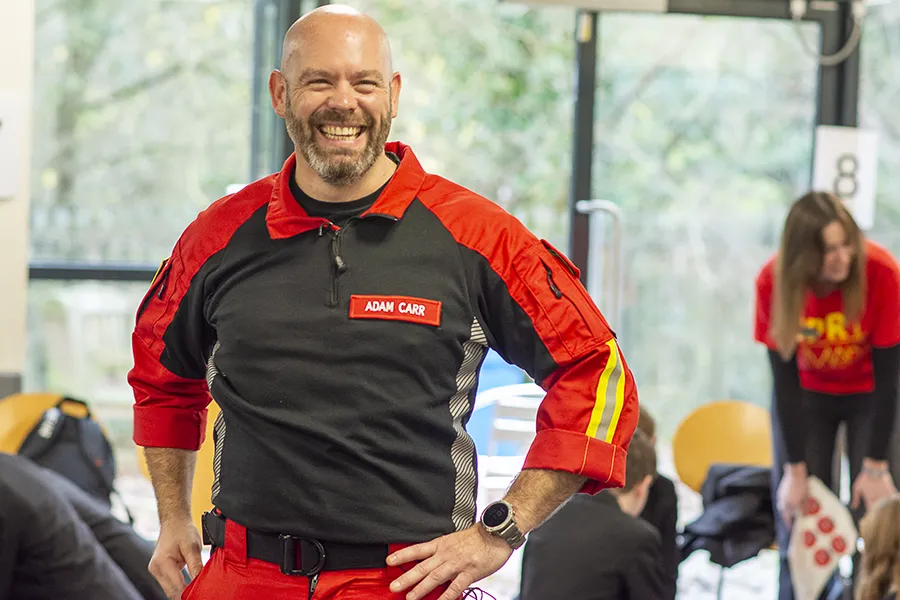
As a Paramedic, how do you stay calm and focused in high-pressure emergency situations?
The moment you put on the uniform, you feel the immense trust the public place in you and that’s incredibly powerful. As a paramedic, you witness some of the most difficult moments in people’s lives, but you also see the very best of humanity. You meet individuals who have stepped in to perform CPR on a stranger, saving a life, and you’re there to support families when outcomes aren’t what we hope for. Even in those toughest moments, being able to provide care, compassion, and reassurance is rewarding in a profoundly different way. I truly love every aspect of my job. From flying over and landing in incredible locations to working alongside such a dedicated team, it’s something I feel genuinely privileged to be part of. Delivering hospital-level critical care at the roadside or in someone’s home, giving every patient the very best possible chance, is something I’m deeply passionate about.When you go out on a call in a helicopter what does the emergency team crew consist of and is a helicopter pilot ever involved or CPR trained?
Our highly skilled crews consist of a pilot, a co-pilot, a pre-hospital care doctor and a critical care paramedic, enabling life-saving procedures to start at the earliest opportunity. Although all members of the crew have very specific skills essentially, we are a team, the pilots will always assist where they can and if they are needed. They have basic CPR training but their help tends to be more logistical, like setting up kit, fetching equipment from the aircraft and assisting with family members or the public.How can the general public be helpful to you at the scene of an accident before you can get there?
The first link in the chain of survival is about recognising someone needs medical assistance and calling 999 as early as possible. Once you have done this the amazing 999 call handler will talk you through what to do if you do not know. However, if you do know how to recognise someone is in Cardiac arrest and know how to perform CPR then please don’t wait to be told to start chest compressions, get on the chest as quickly as you can as every second really does count. If someone is with you send them off to get the closest public access AED (Defibrillator), if you don’t know where that is then the 999 call handler will instruct you. For other incidents if you were a witness to what happened, just being able to provide as much information to the emergency services when they arrive on scene could be helpful.What essential equipment do you carry onboard a helicopter, is it comparable to a road ambulance?
The Essex and Herts Air Ambulance crew are a Critical Care Team and so need to carry medical equipment to allow us to deliver hospital level care in the pre-hospital setting. We carry extended diagnostic equipment such as portable ultrasound units to allow us to look at heart function and to gain arterial access, pupilometers to accurately compare pupil response in patients suffering head injury, syringe drivers to infuse various drugs over a specific time, the list goes on. We introduced blood on board in 2019. On average, our critical care team treats approximately 60 patients in desperate need of a blood transfusion at the scene of an incident every year. By carrying bags of O-negative red blood cells, blood plasma, blood warmer and specialist coolboxes in the helicopters and rapid response vehicles (RRVs) our team provide extra care to patients suffering significant blood loss.So how long does it take to scramble a helicopter crew when an emergency comes in?
We are activated by the East of England Ambulance Service NHS Trust (EEAST), which covers Essex, Hertfordshire, Bedfordshire, Suffolk, Cambridgeshire and Norfolk. 999 calls come in from across the region and are answered and triaged by call takers. At the same time, they get assessed by a critical care paramedic and a dedicated dispatcher working together on the critical care desk based in the EEAST emergency operation centre in Chelmsford. They are looking for any call that a pre-hospital critical care team can make a difference to. From the time our activation phone alarms to being in the air is around 5 minutes. Our helicopter based at Earls Colne can reach the farthest point in Essex in less than 20 minutes, and the one based at North Weald can reach the farthest point in Hertfordshire in less than 15 minutes. Once a patient is stabilised, the critical care team will triage patients to the most appropriate hospital if they require specialist care. This may save vital minutes between the onset of illness or the time of an accident to the patient receiving specialist medical care in hospital.Is a paramedic as qualified as a pre-hospital care doctor, what can a paramedic do that a Doctor can?
A Pre-Hospital Critical Care Team is highly effective because it combines the complementary skills of an experienced paramedic and a doctor. While their roles, training, and backgrounds differ significantly, each is vital to the team’s success. The critical care paramedic possesses an advanced skill set beyond that of a standard paramedic, along with extensive experience operating in pre-hospital environments. They are accustomed to managing incidents involving multiple agencies and working in challenging conditions, often with limited resources. The doctor contributes additional clinical expertise, including anaesthetic knowledge and surgical skills. Together, this combination creates a highly capable and well-rounded team.If a member of public is the only person at the scene of an accident and the victim is not breathing, is it more dangerous to try CPR than not, if you have never been trained?
It is always worth attempting CPR. We go to all too many scenes where no one has felt able to intervene and it’s simply too late, which is devastating. Early CPR can make the difference between life and death. Each year, around 40,000 outof-hospital cardiac arrests occur in the UK, with survival rates below 10%. Every minute without CPR reduces the chance of survival by 10% making early intervention critical.In a recent article, research suggested women are 27% less likely to have CPR done on them, why do you think that is?
I think people worry about having to touch or expose a woman’s chest. They don’t want to get in trouble for taking off someone’s top. To place the pads of a defibrillator correctly you need to expose the chest and remove a bra – and that’s okay. In an emergency, proper pad placement saves lives, and hesitation can cost them. The reality is that doing CPR may mean the difference between life and death. I’ve never come across a patient who wasn’t grateful they were given CPR.I think a lot of people would find CPR quite daunting and probably requires a calm level head in an emergency situation, is it something that anyone can be trained to do?
Yes – absolutely. Everyone should feel confident to deliver CPR and it’s so important that people feel they can give it a go. Training can help – and I’d certainly encourage everyone to do that if they can but we’ve also put some simple videos together that break it down and make it really simple: https://ehaat.org/life-saving-first-aid/Is there any situations where CPR would not be recommended by a member of the public?
No unless the location of the patient puts their safety at risk. Those first few minutes before the emergency response teams arrive are vital – it’s important to just get on the chest. It can make the difference between life and death.When to do CPR and when to use defibrillator?
Do CPR if you’re on your own as you shouldn’t stop chest compressions to get the defibrillator. If there’s a second person on scene, ask them to get the defibrillator while you carry on with CPR then keep going until you’re ready to use it.What sort of injuries to the victim can occur through CPR?
I really wouldn’t want people to worry about that – it’s far more important to do what you can to help someone have the best chance of life. Bystander CPR can be what keeps someone alive until the emergency responses teams arrive. Please remember if any injuries such as broken ribs do occur, they can be fixed, what can’t be fixed is potential damage to the brain caused by no circulating blood feeding it with oxygen.What advice would you give to anyone who would like to learn to do CPR and how to go about it.
Start with the videos we created online – they give a really good step by step guide: https://ehaat.org/life-saving-first-aid/Is CPR practised in schools?
If we can embed CPR skills early, we can arm future generations with the ability to be potential lifesavers. While learning CPR is part of the secondary school curriculum, schools often lack the resources – and knowledge – to deliver this effectively. Our CPR Smart™ programme offers free CPR and defibrillator training to schools across Essex and Hertfordshire, with sessions delivered by our CPR Smart clinical team. The programme is tailored to suit different age groups and educational settings. In primary schools, we train staff not only in CPR and AED use, but also in how to confidently pass these skills on to their pupils. Once trained, they become Essex & Herts Air Ambulance CPR Champions, empowering their schools to become fully CPR Smart. In secondary schools and colleges, we take a slightly different approach by training sixth form students to become CPR Smart Champions. These students then go on to teach their peers, helping to create a ripple effect of life-saving knowledge throughout their school communities. Essex & Herts Air Ambulance has already trained over 400 Champions across over 50 schools, building skills in hundreds more pupils.Over the last few years what would you say the most frequent accident emergency is that you get called out for, i.e knife crime, car accidents, etc.
In 2025 Essex & Herts Air Ambulance teams were dispatched on 2,491 missions and on average we attend 1,900 patients a year. In 2024/25, we went to 498 road traffic collisions, 1,036 medical emergencies, 357 accidental injuries, and 481 other trauma incidents. We assisted in 571 cardiac arrests and 427 of those patients received bystander CPR which is brilliant.
Like many UK air ambulance services, we are a charity that receives no direct government funding, yet it costs around £1 million every month to keep the service running. We rely on the incredible generosity of the people and businesses that we serve across Essex and Hertfordshire. It’s rare to meet someone locally who hasn’t been affected in some way, or doesn’t know someone who has, by the care provided by the Essex & Herts Air Ambulance team. That’s why continued support is so vital. It allows us to be there for people on the worst days of their lives, to support them beyond the initial incident, and to keep evolving – enhancing our skills, equipment, and capabilities so we can deliver the very best care for the patients of today and tomorrow.
Find out more at ehaat.org.
