
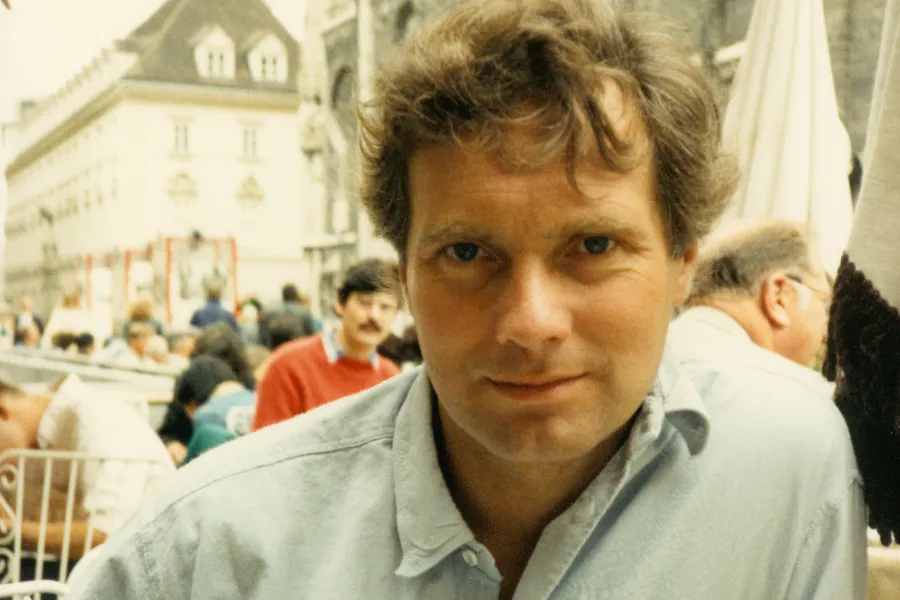
With Hilary Allan as a partner, the practice ran smoothly. There was, however, the semantic problem that arose from fact that the word ‘partner’ was being increasingly usurped to describe somebody with whom you lived/slept … so I always had to qualify introductions: “This is my partner, Hilary – my partner in the practice, that is – we’re not romantically involved!”
One continuing bugbear was 24/7 cover. GPs at that time were expected to provide round the clock emergency cover for their patients. For much of my time in general practice there were no mobile phones and no bleeps … so you were tied to a landline. Large practices had rotas – so you perhaps only had to be on call one night and one weekend in seven. In small practices, however, the ‘on calls’ were far more onerous.
The advantage of this system for the patients was that you tended to see a doctor out of hours who knew you and your history. The major disadvantage for the providers, however, was that doctor had to work the following day … so fatigue and burn-out were significant problems. You are more likely to make mistakes if you’re sleep deprived – and, for those making life and death decisions, this is a worry. Imagine hearing a pilot greeting you as follows: “Welcome to this flight to San Francisco on a beautiful Monday morning. I’ve been working all weekend and I haven’t had much sleep … so this is the last message we’ll be making for a few hours as me and the co-pilot will be taking a little nap.” Doctors, however, were thought to be immune to the adverse effects of sleep deprivation. This myth was perpetuated by the ‘hard men’ who did seem to be able to cope with extraordinarily long hours. For example, as a junior hospital doctor, I worked with Prof. Roy Calne in Cambridge and he would cheerily stick around in theatres for the morning list having spent most of the night doing a liver transplant … whist I was wilting. Likewise Lloyd Rankin, one of the ‘Obs and Gobs’ consultants at St John’s Hospital in Chelmsford, would, after a bruisingly busy day in the operating theatre, turn up on the wards at all hours to follow up patients he felt needed his personal attention. Whilst the strain would have taken its toll on lesser mortals, both celebrated their 90th birthday before popping their clogs.
As for general practice … when on call you could divert the practice phone to your home phone but, as I’ve mentioned before, a spouse had to ‘man’ the phone … which meant staying in all weekend. What’s more, anything other than the briefest of calls to relatives and friends were banned as these could block the line when somebody having a heart attack, a stroke or a severe asthma attack was desperately trying to get through.
Latterly there was a deputising service in Southend from which you could buy cover out of hours … but it only extended as far as Hullbridge because it took too long to get to SWF by road and the deputising doctors rather selfishly refused to swim across the Crouch.
As time went by, there was increasing demand from patients ‘out of hours’ which ran parallel with increasing discontent amongst those having to provide that cover. (The BMA worked out that, at one time, GPs were paid as little as 50p an hour for ‘out of hours’ work.) For these reasons, I became one of the GPs who championed the end of 24 hr cover. That said, after we’d won the battle, I still made myself available during ‘unsocial hours’ for patients who, for example, had special needs (such as terminal care) … but that was far less stressful and far more satisfying than working under the old system.
While all this was going on I managed to slip in a certain amount of media work which was enjoyable and doubled as ‘postgraduate training’. For example, interviewing consultants who were trailblazers was a good way of picking up revolutionary new ideas for managing patients with ‘hard to treat’ conditions … and what I learned (and the contacts I made) when making a documentary for Channel 4 called ‘Concerning Cancer’ was invaluable when dealing with patients with a variety of malignancies.
MATERNITY LEAVE posed problems for practices. When ‘lady doctors’ (as they were then called) had babies, there was no additional funding for the maternity leave they were rightly entitled too as the NHS was always slow to move with the times. This wasn’t much of a problem when general practice was ‘male dominated’ but, as the number of female GPs rose (which was undoubtedly a move in the right direction), it gained significance. Large practices could more easily absorb the additional workload … but small practices were obliged to employ locums to cope with the workload … a costly exercise. Over the years I had favoured working with female GPs as they were VERY popular with the patients and brought a much valued additional dimension to the practice. Maternity leave did put a huge additional strain on a small practices, though – we had to cut expenditure to the bone and beyond (e.g. stopping having milk delivered) – but I considered it a price well worth paying!
Dr John Cormack