
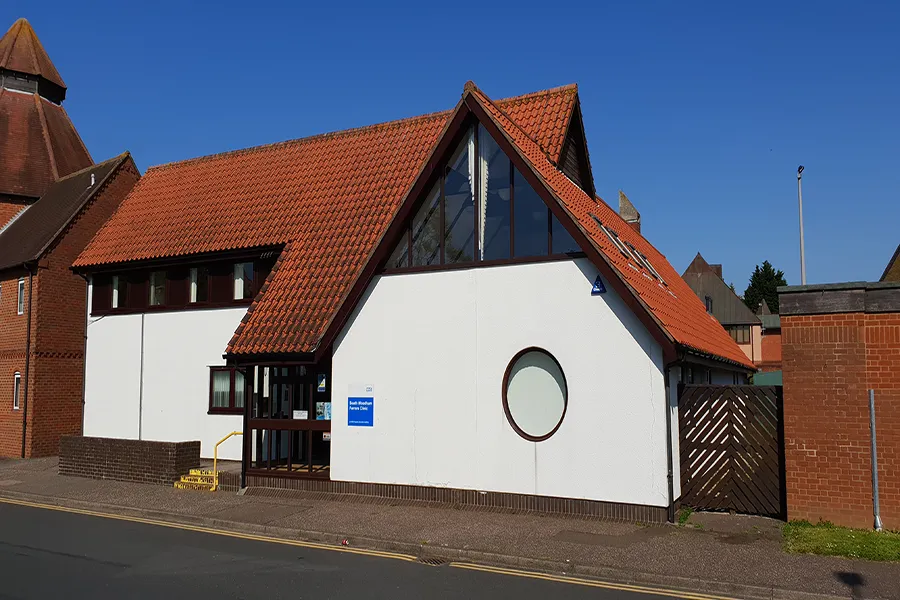
Following on from the article which I listed a series of closures of health service premises in the area, one of the most significant for the residents of SWF was the closure of the town centre Health Clinic.
Those who’ve lived here for a long time will recall that this the construction of the town centre Health Clinic was a significant step in moving the town away from the era in which health services were provided in makeshift premises (such as the tin Chapel in Hullbridge Rd and the Caravan parked in what became Warwick parade) to the 20th century. Essex County Council had constructed the new town without any serious thought for healthcare facilities – so the Clinic got the go ahead as a result of overwhelming pressure from the residents backed by the Parish Council … thereby providing a lesson which should filed away for future use.
As such it was extremely popular and provided a very good service over the years. At its peak the district nurses were housed there as were the health visitors. This was helpful both to the public and to the town centre practices (as we could easily have face to face conversations about patients in which we shared a common interest).
There were also consultant-led outpatient clinics held at the Health Clinic – for example there were surgical, ophthalmological and Obs/gynae clinics. Furthermore, an official source listed the following services provided at the Heath Clinic: “sexual health, physiotherapy, children’s speech and language therapy, audiology and assessments for autism.”
There was also a dental clinic which at one time provided a valuable additional service given that it was on the ground floor (unlike the other town centre dental surgeries) … which made it readily accessible to those with disabilities.
It was refurbished at great expense – but unfortunately the refurbishment didn’t meet the requirements of the time. (For example, UK health guidance for dental surgeries requires the floor covering to be extended up the walls in clinical and decontamination areas – and this is a crucial infection control measure.) So it then had to be re-refurbished at further great expense to the taxpayer. Following the refurbishments the number of patients that were seen in this ‘state of the art’ facility could be counted on the fingers of one badly mutilated hand – and the facility was eventually closed – thereby providing a further example of the incompetence of the NHS decision makers in this area.
+++
At some stage a decision was made (far away, behind closed doors, by people who had no knowledge of nor interest in South Woodham) that the town centre Health Clinic should be closed. Needless to say this was done without any form of public consultation and nor was it discussed in advance with the GP practices. The Clinic was then subjected to ‘death by a thousand cuts’ – the same principle that has been applied to the running down of St Peters Hospital in Maldon.
The services it housed were slowly closed down, one by one. In order to disguise the exorbitant cost of the New Surgery in Tyler’s ride, part of it was designated as a ‘health clinic annex’. Those who wanted to start up new services in the town were welcomed with open arms by those running the annex, whereas, if you wanted to rent a room in the Health Clinic, you were told that there was no possibility of a quick decision and, if and when the application was approved, there would be considerable costs involved. This contributed to the ‘running down’ process.
The district nurses were moved out to Anson Close initially and eventually to Maldon and the wonderful team that had been built up over the years was dismantled resulting in the loss of some really, really good district nurses who knew the town and its patients well and provided a brilliant service over the years. Direct communication was made very difficult – everything had to go through a call centre -so this represented a major backward step. Likewise the health visitors were moved out of the Clinic to a new base in Maldon so communication with them was made far more difficult. Morale plummeted and the service took a nosedive. The first the GPs knew about this change was seeing removals vans turning up at the Health Clinic to take the health visitors furniture and equipment to Maldon.
There was also an excellent phlebotomy service based at the Clinic which was a great boon to the local practices and their patients.
The Clinic was eventually run down to the extent that it could be mothballed without creating much of a stir. When it became clear the plan was to permanently close it. however, there was a great deal dissatisfaction given that there had been no form of public consultation and the plan hadn’t been agreed with the town’s GP practices. A small selection of the comments is shown here. A survey was set up which showed overwhelming support for the retention of the Health Clinic in the town centre given Essex County Council’s ‘vision’ for a town centre medical hub had resulted in residences for the elderly being set up around it (in order to make it easy for the residents to access healthcare.) This was all conveniently forgotten as soon as the plans for Crouch Vale Medical Centre were under way – which rubbed salt into the wound. It goes without saying that the views of the residents were ignored.
There was a plan to set up a minibus service in order to ferry the patients who were disadvantaged by the transfer of all services out of the town to the new facility of on the periphery – and funds were provided by the Sainsbury’s site developer for this purpose – but, needless to say, it didn’t materialize. A chunk of these funds were used to improve the bus service – but nobody seemed to notice any lasting improvement and the service is now worse than ever.
So what could have been done better? We GPs should have been more on the ball – as should those representing the interests of the public. The closure was strongly opposed by the Patient Participation Groups (PPGs) but, unfortunately, overall patient representation was fragmented. In Burnham, when a similar scheme was proposed, the town council played an active role in representing the views of the public, but I wasn’t aware of any similar action in SWF. All in all, then, the absence of a ‘united front’ made it relatively easy for those who didn’t have the town’s best interests at heart to get their way.
After the event I sent off a Freedom of Information Act request to the organisation that had taken over responsibility for the building. This showed that a valuable freehold site had been sold at a knock-down price to the private sector. In that no clear answer was given about a question on where the funds raised had ended up, we were left with the suspicion the dosh had disappeared into a NHS ‘black hole’ rather than having been used for the benefit of the town.
Dr. John Cormack