
Sometimes it seemed as if dealing with the bureaucratic chaos that is part and parcel of general practice was taking over our lives … but, despite this, “the show must go on”. The day-to-day encounters with our patients were what made it all seem worthwhile.
Our aim in the practice was to deal with as much as we could ‘in house’ as this saved patients a lot of time (and travelling) and it saved the NHS a lot of money. A lot of our time was, of course, taken up with the bread and butter work of general practice – managing a wide array of everyday health issues, coughs and respiratory issues, mental health concerns, common aches and pains, and infections – plus diagnosing conditions that required referral. There were also the emergencies that required instant expert attention … and I never failed to be amazed at how quickly our nurses would click into gear at these times as if they were reenacting a scene from Casualty or ER.
We did an ‘unbooked surgery’ every weekday morning between 9 and 10 – you could just turn up and we’d guarantee to see you. We also offered minor surgery and a minor injuries services. We’d dress leg ulcers, and irrigate/repack pilonidal sinus wounds after the patients had had their surgery.
We’d drain hydroceles for old gents who’d decided against surgery – and we would change catheters of all sorts (including suprapubic catheters).
On long bank holiday breaks when the surgery was closed we’d do an emergency surgery at times when Mrs Govani’s pharmacy was open (so patients could easily pick up their prescribed medication)
Chronic disease management is a hugely important part of the work of every practice – and, again this was an area where a very strong nursing team produced excellent results. This included conditions such as heart disease and hypertension. The nurses also ran asthma and COPD clinics, focusing on early diagnosis, smoking cessation (for COPD), personalized self-management plans, correct inhaler use, regular check-ups, vaccinations, pulmonary rehabilitation, and managing exacerbations to improve quality of life and prevent hospital visits. At one time we had 4 nurses who were highly skilled in diabetes management (including insulin initiation) and they focused a great deal of time and attention on their patients given that the tighter the control, the less likely it is patients will end up with the serious complication of diabetes (such as blindness, amputations etc.) Patients who’d previously had hospital treatment were pleasantly surprised – particularly when asked to take their socks and shoes off. It’s VERY important to check the feet – including foot pulses (circulation) and sensation in these patients – and surprisingly often, this had never been done before. The high standard of chronic disease management was probably one of the principle reasons why we were told by the CQC that our patients lived longer when compared with the local and national averages.
As for vaccines, we provided all the normal ones plus holiday jabs … including yellow fever.
Because our patients were aware of our dire financial circumstances which, in normal circumstances, would have severely limited what we could do for them, they provided us with all sorts of equipment and we responded by using their gifts to provide additional services. The NHS issued us with what we needed to provide a phlebotomy (blood test) service and we had equipment for ‘run of the mill’ investigations such as ECGs … but the patients provided what we needed for more esoteric investigations etc. Examples include:
A gadget for 24-hour blood pressure (BP) testing (aka Ambulatory Blood Pressure Monitoring). This requires a portable cuff and recorder to be worn for a full day to automatically measure your blood pressure at regular intervals This detects abnormal changes in BP that might otherwise go unnoticed. NICE says: “ABPM is the most accurate method for confirming a diagnosis of hypertension, and its use should reduce unnecessary treatment in adults who do not have true hypertension”
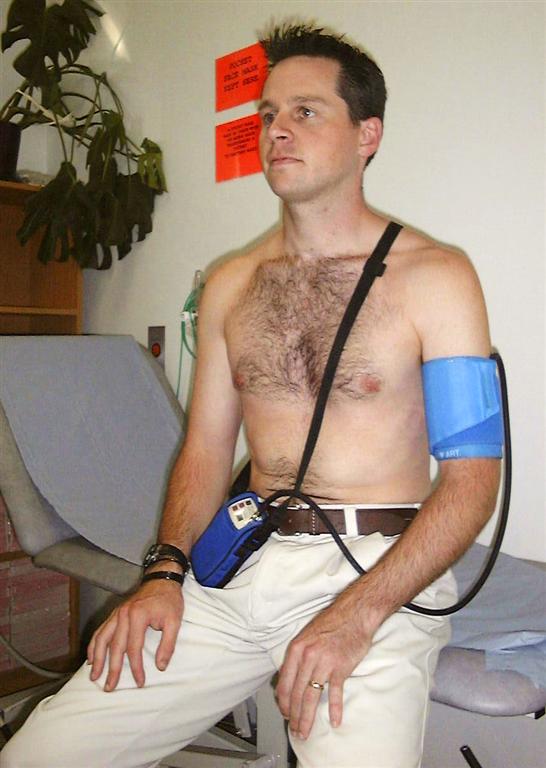
Patient with ambulatory blood pressure monitor
We were also given a Holter monitor – which is a small, portable ECG device that continuously records your heart’s electrical activity (rhythm) for between 24 hours and several days, capturing issues like palpitations, dizziness, or fainting that a standard short ECG might miss. It’s worn with sticky electrodes on your chest so you can go about normal activities while the device records intermittent heart problems.
The patients provided a spirometer: a medical device used for spirometry, a simple lung function test that measures how much air you can breathe in and out, and how fast, helping to diagnose and accurately monitor respiratory conditions like asthma, COPD, or pulmonary fibrosis. We shared a device to regularly check the spirometer was accurate (a Calibration Syringe) with Brickfields Surgery.
As if all this wasn’t enough, we were also bought a FeNO meter (Fractional Exhaled Nitric Oxide meter). This is a medical device that measures nitric oxide in a patient’s breath, which acts as a key biomarker to help diagnose and manage asthma by indicating levels of airway inflammation, thereby guiding treatment with inhaled corticosteroids. These handheld devices provide quick results to help doctors/nurses fine-tune treatment and monitor disease progression.
To cap it all we were provided with a cryosurgery device – a pressurized container holding liquid nitrogen for precise, localized freezing of skin lesions such as warts or skin tags, thereby offering a quick, controlled way to destroy abnormal cells without damaging surrounding healthy tissue.
Storing liquid nitrogen requires specialized, well-insulated dewars or cryogenic tanks with pressure relief valves. There are costly so the surgeries shared one of these.
As for antenatal / intrapartum care and terminal care – I’ll cover that next week.
Dr. John Cormack