

As I never tire of mentioning, Greenwood Surgery was always dependent on its great team of nurses. They enabled us to deliver a high standard of care on a shoestring budget.
The longest serving was my wife, Sue (pictured) and she could turn her hand to just about anything. Another was Nurse Practitioner Karen Bache and here she is talking about what her job involved.
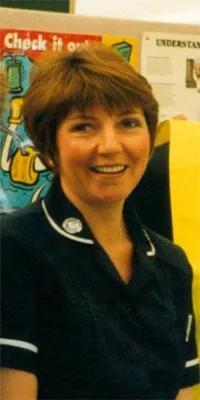
One of the longest serving Nurses, Sue Cormack
The nurses were VERY good at managing ‘chronic conditions’ such as diabetes and COPD. Left to their own devices they did a brilliant job but, from time to time, NHS managers (who knew nothing about general practice and the conditions we dealt with – but felt they had to do something to justify their generous pay and perks) would try to tell them how to do their job. This, then, is Karen pointing out the problems they caused. It’s ‘a bit technical’ but is nevertheless worth a listen.
She mentions COPD (Chronic obstructive pulmonary disease – which used to be called chronic bronchitis and emphysema) … and ‘spirometry’ (which measures how much air you can breathe out in one breath) and is a key lung function test used to diagnose respiratory diseases like asthma and COPD by measuring how much and how quickly a person can exhale air. Not only does it help diagnose these conditions, it also assesses their severity, monitors disease progression, and checks treatment effectiveness – so it’s a vital general practice tool. Karen, who’d been fully trained in its use and had developed a great deal of expertise in treating chest conditions, was not best pleased when ‘the system’ tried to hobble her!
Incidentally patients need a lot of encouragement to keep breathing out until their lungs are pretty much empty. I sometimes passed the door of Karen’s consulting room and heard her saying breathlessly: “keep going, keep going, keep going, keep going, don’t stop, don’t stop, don’t stop, don’t stop! It took me a while to work out what was going on.
Carrying on where I left off with the Springfield ‘walk-in centre’ … the service was run by private companies who were laughing all the way to the bank. The NHS was charged around £55 for each consultation (which, from memory, was significantly more than half of the sum my practice received from the NHS for looking after a patient for an entire year (i.e. the ‘capitation fee’). Most patients appeared to have been seen by clinicians other than doctors and quite a high proportion ended up being sent back to see their GP or referred to A&E.
One of our nurses did a session there. She was asked to do a ‘smear test’ and asked for a Cusco’s speculum (the instrument used to visualise the cervix). The existing staff did a great deal of searching and eventually gave her a proctoscope which was seemingly all they had. Proctoscopes are wholly different instruments intended for an altogether different orifice – they are used to examine the anus and rectum in order to diagnose/treat conditions such as hemorrhoids, polyps, and rectal bleeding. Our nurse didn’t go back as she was worried that her registration could be on the line if she continued working there.
I don’t know how much the Springfield walk-in centre cost the ‘local NHS’ (i.e. the taxpayer) but PCT data showed that the walk-in centres that were set up cost an average of £1.1 million each year. Not only that, they didn’t cut A&E attendances … quite the reverse. As for the national picture – one in four Darzi centres registered fewer than 500 patients, sparking calls from GP leaders to shut them all down. This investigation found that 12 per cent of centres had not registered any patients at all … and one centre had only one registered patient.
Eventually the penny dropped and the Darzi Walk-in Centres were deemed to be ‘an expensive luxury the UK can no longer afford’
The Mid Essex facility had been haemorrhaging £millions over the years but the problem was that it’s easy to open any new NHS facility but very difficult to close it – so the situation dragged on … and on … and on.
Eventually, in late 2014, Dr. Donald McGeachy, doing what he enjoyed most (i.e. working for Mid Essex CCG), released this statement: “In taking its decision the board paid regard to the feelings of the public from the consultation we carried out earlier in the year. However, this was balanced against a thorough review of the activity at the walk in service which indicates that it hasn’t succeeded in its primary aim of reducing A and E attendance.”
It was finally laid to rest in March 2015.
Dr. John Cormack